4th grade waves, light and senses
Quick answer
In 4th grade (ages 9–10), children model waves by amplitude and wavelength, learn that we see when light reflects into our eyes, and explore how animal senses work. Start with Generation Genius "Waves for Kids", then light, eyes and SciShow Kids animal senses. Play all on repeat, or loop one diagram.
Videos in this playlist
- 1
 Waves for Kids | Wavelength & Amplitude | Science Lesson for Grades 3-5 | Mini-ClipGenerationGeniusPlay from here Loop
- 2
 What Are Waves? | Science at the Beach! | SciShow KidsSciShow KidsPlay from here Loop
- 3
 Wave Motion | Waves | Physics | FuseSchoolFuseSchool - Global EducationPlay from here Loop
- 4
 Transverse & Longitudinal Waves | Waves | Physics | FuseSchoolFuseSchool - Global EducationPlay from here Loop
- 5
 What Is Sound? for KidsLearn BrightPlay from here Loop
- 6
 What is Sound? | Physics for Kids | SciShow KidsSciShow KidsPlay from here Loop
- 7
 Light for Kids | Where does light come from? Learn all about light in this fun introduction video.Learn BrightPlay from here Loop
- 8
 Science of LIGHT for Kids | Reflection & Vision | Lesson for Grades 3-5GenerationGeniusPlay from here Loop
- 9
 The Human Eye for Kids | Learn why and how eyes allow us to seeLearn BrightPlay from here Loop
- 10
 How Eyes Let Us See The World | SciShow KidsSciShow KidsPlay from here Loop
- 11
 The Science of Light and Color for Kids: Rainbows and the Electromagnetic Spectrum - FreeSchoolFree SchoolPlay from here Loop
- 12
 What Is a Rainbow? | Rainbows for Kids | Learn how and why rainbows formLearn BrightPlay from here Loop
- 13
 Senses and the Brain Video Lesson for Kids | Science Lesson for Grades 3-5 | Mini-ClipGenerationGeniusPlay from here Loop
- 14
 Senses You Didn’t Know You Have | SciShow KidsSciShow KidsPlay from here Loop
- 15
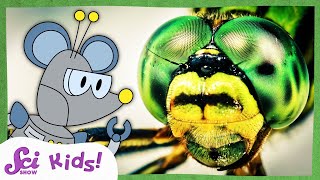 How Do Insect Eyes Work? | Compound Eyes | Amazing Animal Senses | SciShow KidsSciShow KidsPlay from here Loop
- 16
 How Do Bats See with Sound? | Echolocation | Amazing Animal Senses | SciShow KidsSciShow KidsPlay from here Loop
- 17
 Why Do Animals Have Whiskers? | Amazing Animal Senses | SciShow KidsSciShow KidsPlay from here Loop
- 18
 How Do Snakes Smell With Their Tongues? | Amazing Animal Senses! | SciShow KidsSciShow KidsPlay from here Loop
- 19
 How Sharks Find Food With Electricity! | Amazing Animal Senses | SciShow KidsSciShow KidsPlay from here Loop
- 20
 Information Transfer Video for Kids | Morse Code 101010 | Science Lesson for Grades 3-5 | Mini-ClipGenerationGeniusPlay from here Loop
- 21
 Communication Using Light and Sound | Science for Kids | Kids AcademyKids AcademyPlay from here Loop
- 22
 Science Max | FULL EPISODE | Light Challenge | Season 2Science Max - ScholasticPlay from here Loop
- 23
 🔊Science Max - SOUND - Home Experiments🔊Science Max - ScholasticPlay from here Loop
- 24
 Your Body's Senses | SciShow Kids CompilationSciShow KidsPlay from here Loop
What does this waves and light unit cover?
It covers wave patterns, amplitude and wavelength, sound as a wave, light and reflection, how the eye sees, and how animals use senses like echolocation. It ends with sending messages using patterns. A child should explain how light lets us see an object.
How does RepeatWatch help with waves and light?
Set an A–B loop on one diagram, like light bouncing into an eye, and pause to draw it. Slow animations to 0.75×, save the waves, light and senses parts on keys 1–9, and stop after a few loops to keep screen time short.
Frequently asked questions
What grade learns about waves and light?
In the US, the NGSS 4th grade standards (4-PS4 and 4-LS1) cover wave patterns, how light reflecting from objects lets us see, and how animals take in information through senses. Grade levels vary by country and school.
What is a good hands-on follow-up?
Try a flashlight and mirror to bounce light onto a target, or a slinky to show waves. Watch the related clip first, then replay the key part afterward to compare what you saw with the explanation.