6th grade character, plot and theme videos
Quick answer
In 6th grade (ages 11–12), students follow how a plot unfolds, how characters respond and change, and how a theme develops. This playlist starts with Khan Academy on the elements of a story, adds Learn Bright and TED-Ed on heroes and suspense, then covers theme and summaries. Repeat one explanation with an A–B loop.
Videos in this playlist
- 1
 The elements of a story | Reading | Khan AcademyKhan AcademyPlay from here Loop
- 2
 What Is an Antagonist? | Learn all about the antagonist character and how to spot them in storiesLearn BrightPlay from here Loop
- 3
 Character actions in stories | Reading | Khan AcademyKhan AcademyPlay from here Loop
- 4
 Characters' thoughts and feelings | Reading | Khan AcademyKhan AcademyPlay from here Loop
- 5
 Character change | Reading | Khan AcademyKhan AcademyPlay from here Loop
- 6
 What makes a hero? - Matthew WinklerTED-EdPlay from here Loop
- 7
 How to make your writing suspenseful - Victoria SmithTED-EdPlay from here Loop
- 8
 How to build a fictional world - Kate MessnerTED-EdPlay from here Loop
- 9
 Understanding theme | Reading | Khan AcademyKhan AcademyPlay from here Loop
- 10
 Developing themes | Reading | Khan AcademyKhan AcademyPlay from here Loop
- 11
 Messages and morals | Reading | Khan AcademyKhan AcademyPlay from here Loop
- 12
 Comparing and contrasting themes in myths and traditional stories | Reading | Khan AcademyKhan AcademyPlay from here Loop
- 13
 Making objective summaries of literary texts | Reading | Khan AcademyKhan AcademyPlay from here Loop
- 14
 Summarizing stories | Reading | Khan AcademyKhan AcademyPlay from here Loop
- 15
 Summarizing a story with SWBST | Reading | Khan AcademyKhan AcademyPlay from here Loop
- 16
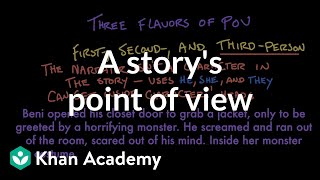 A story's point of view | Reading | Khan AcademyKhan AcademyPlay from here Loop
- 17
 First person vs. Second person vs. Third person - Rebekah BergmanTED-EdPlay from here Loop
What should a 6th grader be able to do after this unit?
Describe how a plot unfolds in episodes, explain how characters respond and change as the story moves toward a resolution, find a theme and show how details develop it, and write an objective summary. Grade levels vary by country and school.
How does RepeatWatch help with literary analysis?
Loop the part of a lesson that models how to find a theme, then try it on a book you are reading. Slow a fast talker to 0.75×, save each lesson part on keys 1–9, and use Stop after N loops for short sessions.
Frequently asked questions
What is the difference between a theme and a topic?
A topic is what a story is about in a word or two, such as friendship. A theme is the message about it, such as true friends tell hard truths. The Khan Academy videos on understanding and developing themes explain this.
Why are there TED-Ed videos about writing stories?
Seeing how writers build heroes, suspense and fictional worlds helps students notice those choices when they read. The TED-Ed lessons introduce the hero’s journey, plot tension and setting in a few minutes each.