6th grade pronouns and sentence structure
Quick answer
In 6th grade (ages 11–12), students use subject and object pronouns correctly, fix vague pronouns, vary their sentences and set off extra information with commas, dashes or parentheses. This playlist uses Khan Academy’s grammar lessons on pronouns, syntax and punctuation. Repeat one rule with an A–B loop until it sounds natural.
Videos in this playlist
- 1
 What is a pronoun? | The parts of speech | Grammar | Khan AcademyKhan AcademyPlay from here Loop
- 2
 Personal pronouns | The parts of speech | Grammar | Khan AcademyKhan AcademyPlay from here Loop
- 3
 Subject and object pronouns | The parts of speech | Grammar | Khan AcademyKhan AcademyPlay from here Loop
- 4
 Grammatical person and pronouns | The parts of speech | Grammar | Khan AcademyKhan AcademyPlay from here Loop
- 5
 Pronoun number | The parts of speech | Grammar | Khan AcademyKhan AcademyPlay from here Loop
- 6
 Possessive pronouns | The parts of speech | Grammar | Khan AcademyKhan AcademyPlay from here Loop
- 7
 Reflexive pronouns | The parts of speech | Grammar | Khan AcademyKhan AcademyPlay from here Loop
- 8
 Emphatic pronouns | The parts of speech | Grammar | Khan AcademyKhan AcademyPlay from here Loop
- 9
 Relative pronouns | The parts of speech | Grammar | Khan AcademyKhan AcademyPlay from here Loop
- 10
 Indefinite Pronouns | The parts of speech | Grammar | Khan AcademyKhan AcademyPlay from here Loop
- 11
 Who versus whom | The parts of speech | Grammar | Khan AcademyKhan AcademyPlay from here Loop
- 12
 Pronoun-antecedent agreement | Syntax | Khan AcademyKhan AcademyPlay from here Loop
- 13
 Three types of sentence | Syntax | Khan AcademyKhan AcademyPlay from here Loop
- 14
 Simple and compound sentences | Syntax | Khan AcademyKhan AcademyPlay from here Loop
- 15
 Dependent and independent clauses | Syntax | Khan AcademyKhan AcademyPlay from here Loop
- 16
 Complex sentences | Syntax | Khan AcademyKhan AcademyPlay from here Loop
- 17
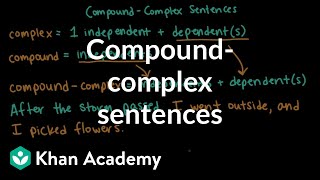 Compound-complex sentences | Syntax | Khan AcademyKhan AcademyPlay from here Loop
- 18
 Recognizing fragments | Syntax | Khan AcademyKhan AcademyPlay from here Loop
- 19
 Run-ons and comma splices | Syntax | Khan AcademyKhan AcademyPlay from here Loop
- 20
 Appositives | Punctuation | Grammar | Khan AcademyKhan AcademyPlay from here Loop
- 21
 Dashes | Punctuation | Khan AcademyKhan AcademyPlay from here Loop
- 22
 Parentheses | Punctuation | Khan AcademyKhan AcademyPlay from here Loop
- 23
 Hyphens vs. dashes | Punctuation | Khan AcademyKhan AcademyPlay from here Loop
What should a 6th grader be able to do after this unit?
Choose subject or object pronouns, use intensive pronouns such as myself, keep pronouns in agreement with what they refer to, write simple, compound and complex sentences, fix fragments and run-ons, and punctuate extra information. Grade levels vary by country and school.
How does RepeatWatch help with grammar?
Repeat one short lesson, such as who versus whom, until the rule feels familiar. Loop a single example with A–B, slow it to 0.75× to read along, save each rule on keys 1–9, and use Stop after N loops to keep practice brief.
Frequently asked questions
What is pronoun case?
Case is the form a pronoun takes for its job in a sentence: I, he and they as subjects, me, him and them as objects, and mine or theirs for possession. The Khan Academy subject and object pronouns video explains it.
What are intensive pronouns?
Intensive pronouns, such as myself or themselves, add emphasis, as in “I fixed it myself.” Khan Academy calls them emphatic pronouns. They look like reflexive pronouns, and the playlist covers both back to back.