7th grade phrases, clauses and sentences
Quick answer
In 7th grade (ages 12–13), students learn how phrases and clauses work, and choose simple, compound, complex and compound-complex sentences to show how ideas relate. Lessons from Khan Academy "Phrases and clauses" and "Complex sentences", plus Learn Bright on conjunctions. Play all on repeat, or loop one example.
Videos in this playlist
- 1
 Phrases and clauses | Syntax | Khan AcademyKhan AcademyPlay from here Loop
- 2
 Prepositional phrases | The parts of speech | Grammar | Khan AcademyKhan AcademyPlay from here Loop
- 3
 Appositives | Punctuation | Grammar | Khan AcademyKhan AcademyPlay from here Loop
- 4
 Dependent and independent clauses | Syntax | Khan AcademyKhan AcademyPlay from here Loop
- 5
 Relative clauses | Syntax | Khan AcademyKhan AcademyPlay from here Loop
- 6
 Relative pronouns | The parts of speech | Grammar | Khan AcademyKhan AcademyPlay from here Loop
- 7
 Coordinating conjunctions | The parts of speech | Grammar | Khan AcademyKhan AcademyPlay from here Loop
- 8
 Coordinating Conjunctions FANBOYS | Learn the acronym to remember the conjunctions!Learn BrightPlay from here Loop
- 9
 BONUS: "FANBOYS," a mnemonic song | Conjunctions | Parts of speech| Khan AcademyKhan AcademyPlay from here Loop
- 10
 Subordinating conjunctions | The parts of speech | Grammar | Khan AcademyKhan AcademyPlay from here Loop
- 11
 Subordinating Conjunctions | Learn about how to use subordinating conjunctionsLearn BrightPlay from here Loop
- 12
 What is a sentence? | Syntax | Khan AcademyKhan AcademyPlay from here Loop
- 13
 Simple and Compound Sentences for Kids | Learn the difference between simple and compound sentencesLearn BrightPlay from here Loop
- 14
 Simple and compound sentences | Syntax | Khan AcademyKhan AcademyPlay from here Loop
- 15
 Complex sentences | Syntax | Khan AcademyKhan AcademyPlay from here Loop
- 16
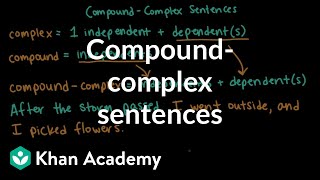 Compound-complex sentences | Syntax | Khan AcademyKhan AcademyPlay from here Loop
- 17
 Recognizing fragments | Syntax | Khan AcademyKhan AcademyPlay from here Loop
- 18
 Run-ons and comma splices | Syntax | Khan AcademyKhan AcademyPlay from here Loop
- 19
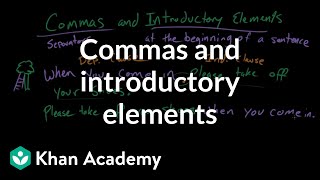 Commas and introductory elements | Punctuation | Grammar | Khan AcademyKhan AcademyPlay from here Loop
- 20
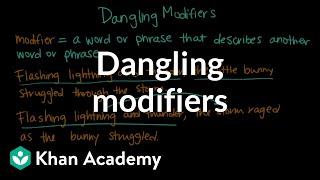 Dangling modifiers | Syntax | Khan AcademyKhan AcademyPlay from here Loop
- 21
 Parallel structure | Syntax | Khan AcademyKhan AcademyPlay from here Loop
What does this 7th grade grammar unit cover?
It introduces phrases and clauses, prepositional phrases and appositives, independent and dependent clauses, conjunctions, the four sentence types, fragments and run-ons, and misplaced or dangling modifiers. By the end a student should combine two simple sentences into a compound or complex one and explain the choice.
How does RepeatWatch help with grammar?
Set an A–B loop on one example sentence as the teacher takes it apart, and replay it until you can label each clause yourself. Slow a quick explanation to 0.75×, save each sentence type on keys 1–9, and use Stop after N loops.
Frequently asked questions
What is the difference between a phrase and a clause?
A clause has a subject and a verb; a phrase does not. An independent clause can stand alone as a sentence, while a dependent clause needs one. Khan Academy's "Phrases and clauses" and "Dependent and independent clauses" explain this step by step.
What grade learns complex sentences?
In the US, 7th grade (ages 12–13) asks students to use simple, compound, complex and compound-complex sentences on purpose. Grade levels vary by country and school, so start with the Learn Bright videos if conjunctions are new.